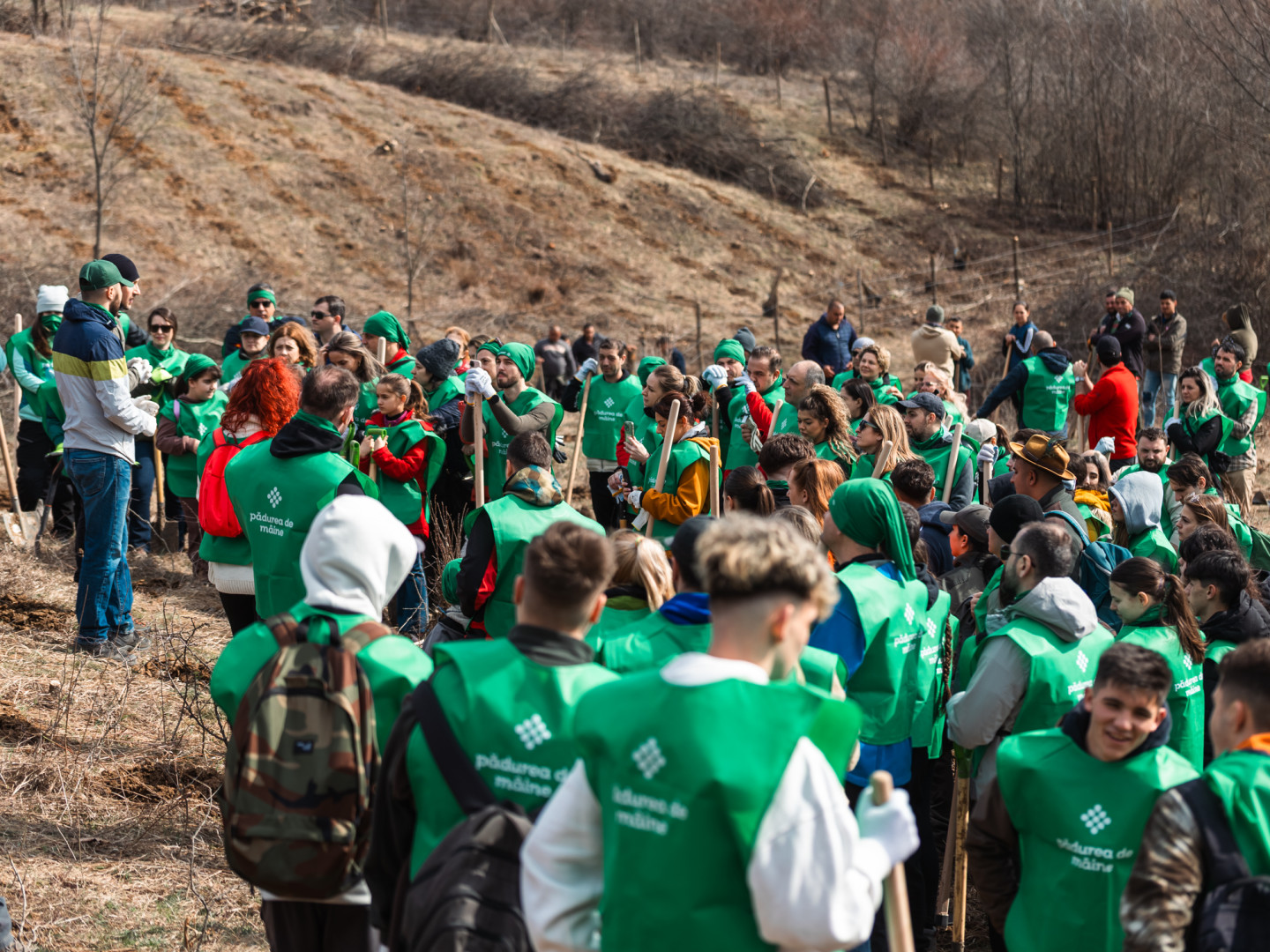
Last Friday, the courtyard of the Saint Mary Special High School for the Hearing Impaired in Bucharest was transformed into a play and planting workshop for students, teachers, volunteers of the Tomorrow’s Forest Foundation and the Clarfon team. Together, the nearly 50 participants laid the foundations for a new urban mini-forest – an initiative that combines environmental education, social responsibility and the joy of planting life.
The project, part of the “Forest in the Schoolyard” programme of the Tomorrow’s Forest Foundation, mobilised the community to plant 1,400 seedlings of 12 native species – from oaks and ashes to common dogwood, dog rose and pine. Through the method of the Japanese botanist Akira Miyawaki, these plantations have a high density and create the conditions for the rapid formation of a mature forest, in a much shorter time than in the case of traditional plantations.
A living laboratory for learning
For many of the children, the action was more than an outdoor activity: it was a lesson lived, an opportunity to understand nature by actually putting their hands in the ground and supporting a fragile seedling to find its place in the world.
“Children learn much more easily through direct involvement than if I wrote an equation on the board,” said Florica Stoica, the director of the high school. “The experience remains for life. The forest for us equals childhood: play, discovery, emotion.”
For some students, this was their first authentic contact with a forest in the making. The story of touching the first seedling – “they had never seen one before” – talks about how important it is for nature to be accessible to all children, regardless of their context.

“You are the tomorrow’s forest”
For Clarfon representatives, the meeting with the hearing-impaired students had a deep meaning. “When I saw you, I realised that you are the tomorrow’s forest,” said Ionuț Ștefanescu, the general manager of Clarfon. “A planted tree is more than a symbolic gesture – it is a real contribution to the life of the community.”
Friday’s planting was the sixth of the Clarfon campaign “One Patient Fitted with a Prosthesis. One Tree Planted.”, which started in 2021.
Ionuț Ștefănescu underlines the special significance of this project: “Planting an urban mini-forest with the students at a school for children and young people with hearing impairments has a special meaning. In this project, nature becomes a space accessible to everyone, a place where they can explore and interact with the environment at their own pace.”

From theory to practice: how to plant a Miyawaki forest
Before actually starting work, the team of the Tomorrow’s Forest Foundation explained to the children what they have to do: teams of two for each shovel, one child holding the seedling straight, the other carefully covering the root. Each pit already had a seedling prepared, and the pace of work quickly became a natural one, full of energy and laughter.
Mihail Caradaică, executive director of the Tomorrow’s Forest Foundation, spoke about the role of these forests: “They create microclimates that cool the area, filter the air and bring biodiversity. They will attract birds, beneficial insects and, in a short time, they will become a green oasis right in the schoolyard.“

Enthusiasm and belonging: every child with their own tree
Before the action, the students competed in their desire to participate. Everyone wanted to have their own “tree”, which they could take care of or “decorate” at future Christmas competitions.
“We feel great, it’s a very nice experience,” said Alex, 16. “We learn how to plant, how to take care of nature.”
Teachers say that although many of the lessons taught in the classroom can be forgotten, the experiences lived in nature remain forever. And the green patch now planted in the schoolyard will be, for years in a row, a place of growth – for the seedlings, but also for the children.


The fourth tiny school forest of the Tomorrow’s Forest Foundation
This is the fourth tiny school forest planted by the Foundation through the Miyawaki method, after those at the Hermann Oberth German School in Voluntari, Elementary School no. 150 from the Cotroceni neighbourhood and from the Țara Bârsei Technical College in Prejmer, Brașov county.
Every tree planted carries on the idea that health is not just about medical care, but also environments where people can live better, breathe better, and feel part of a healthy ecosystem.