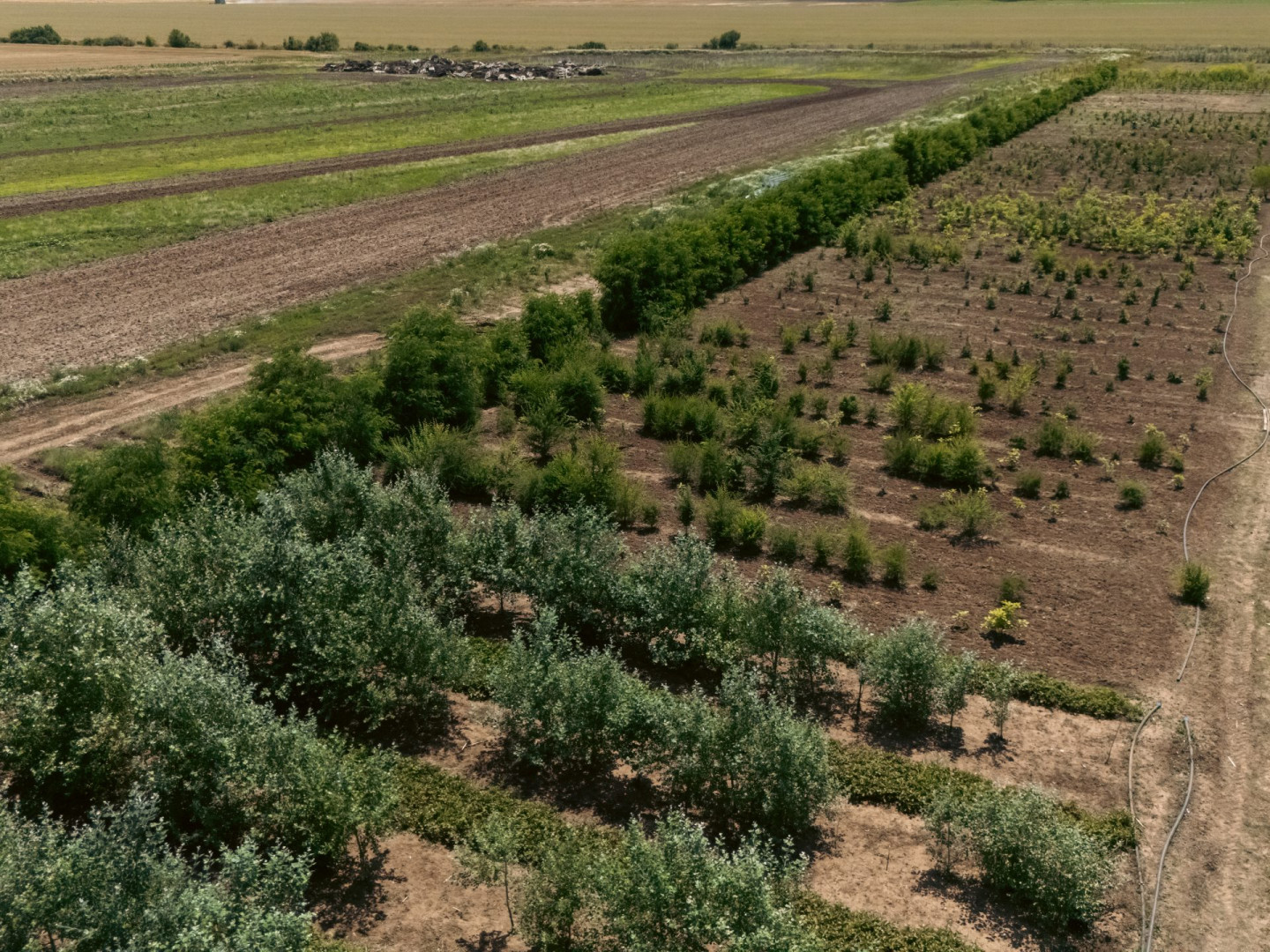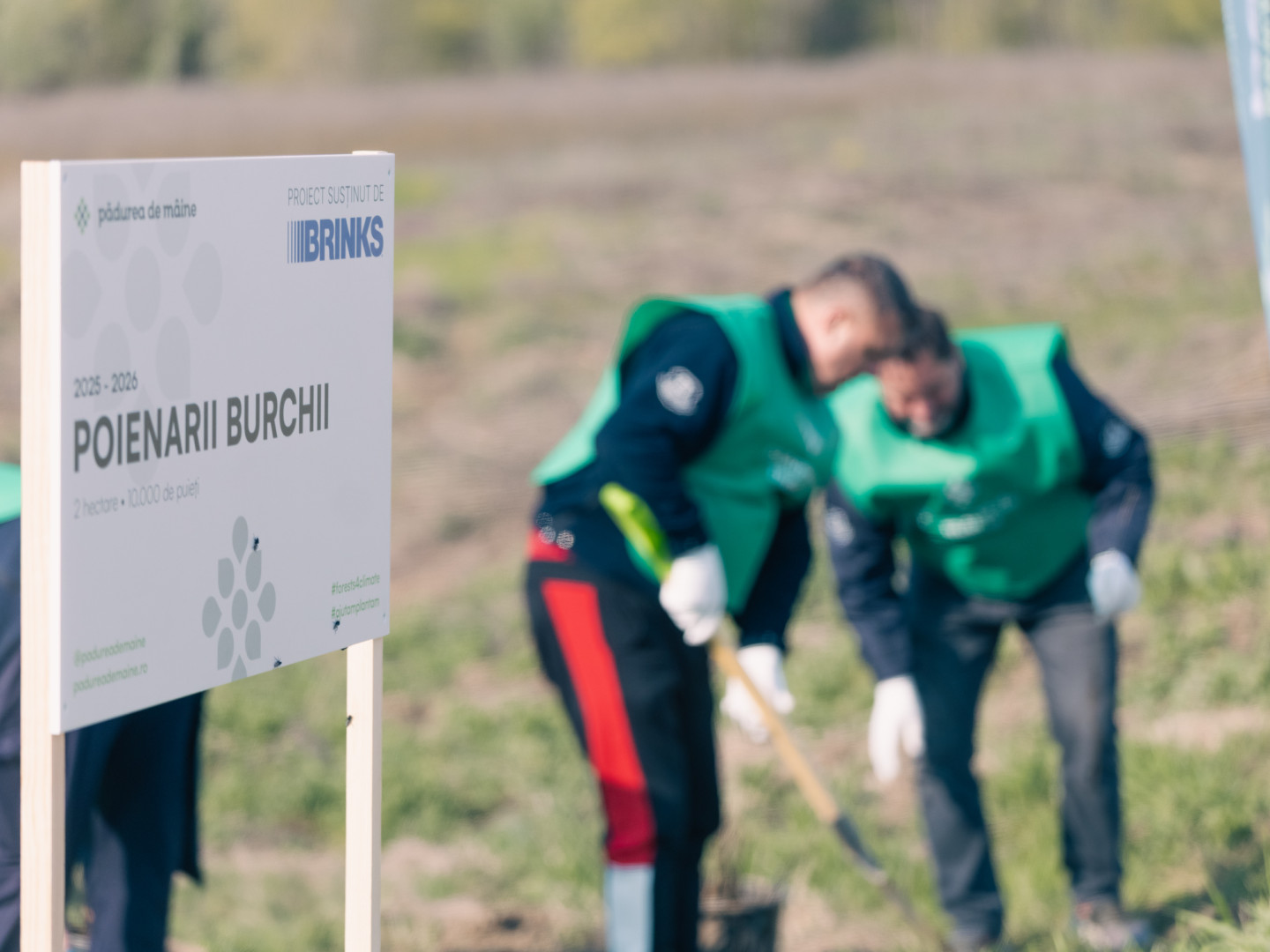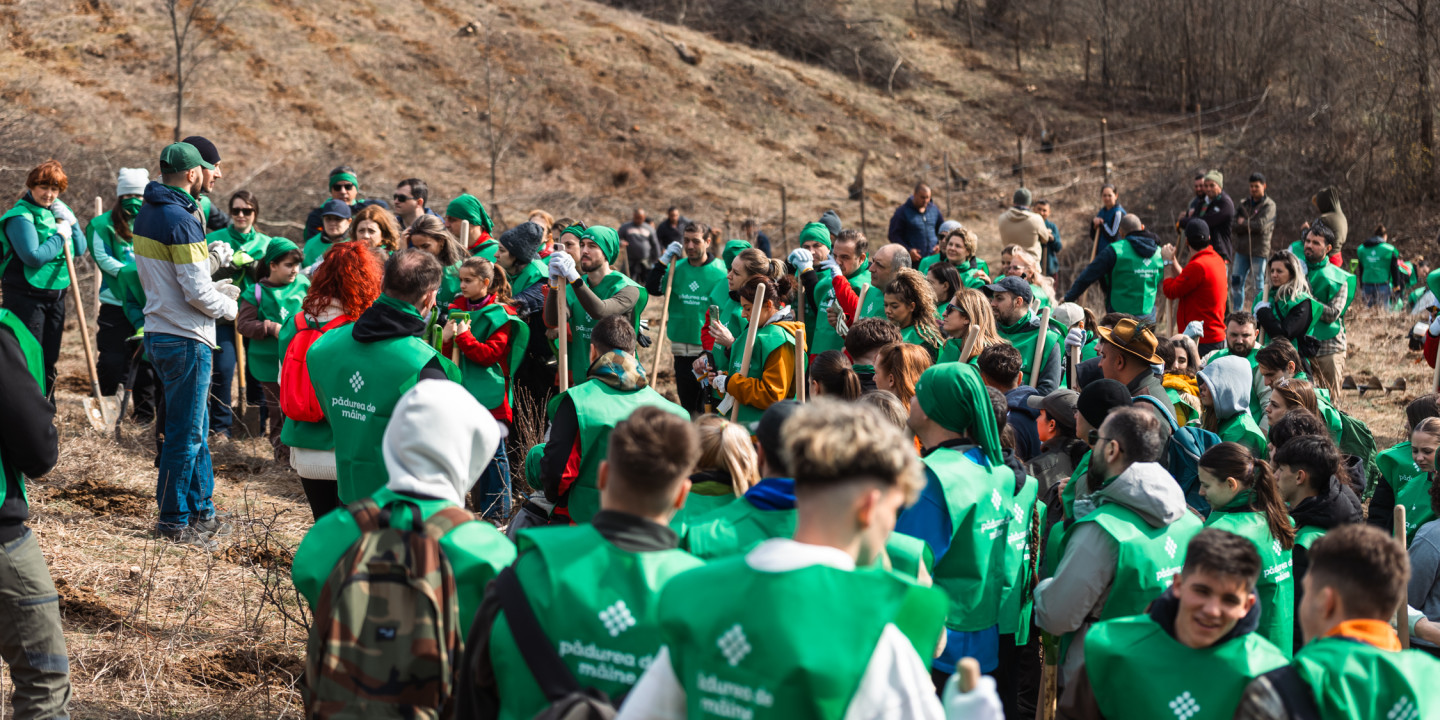
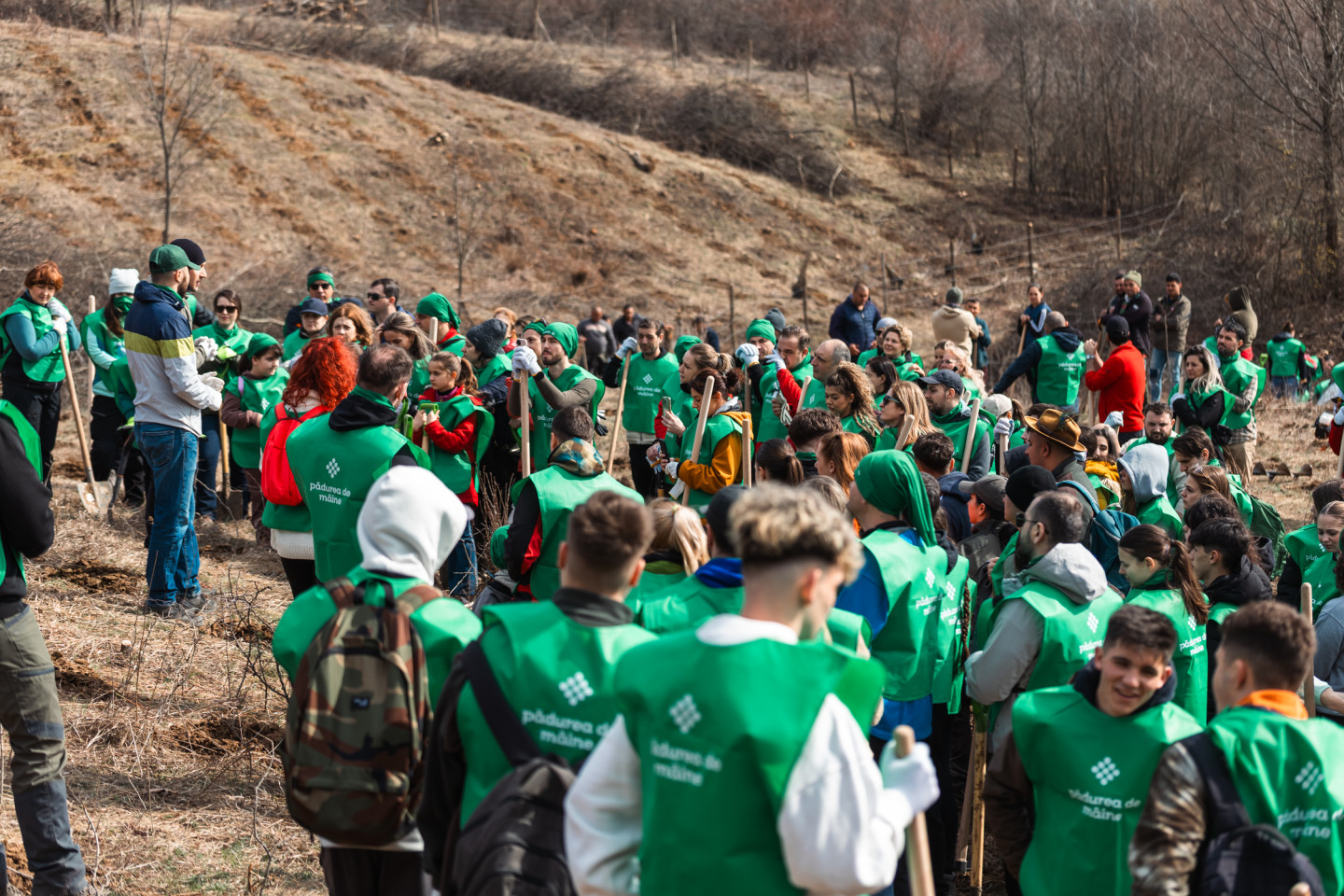
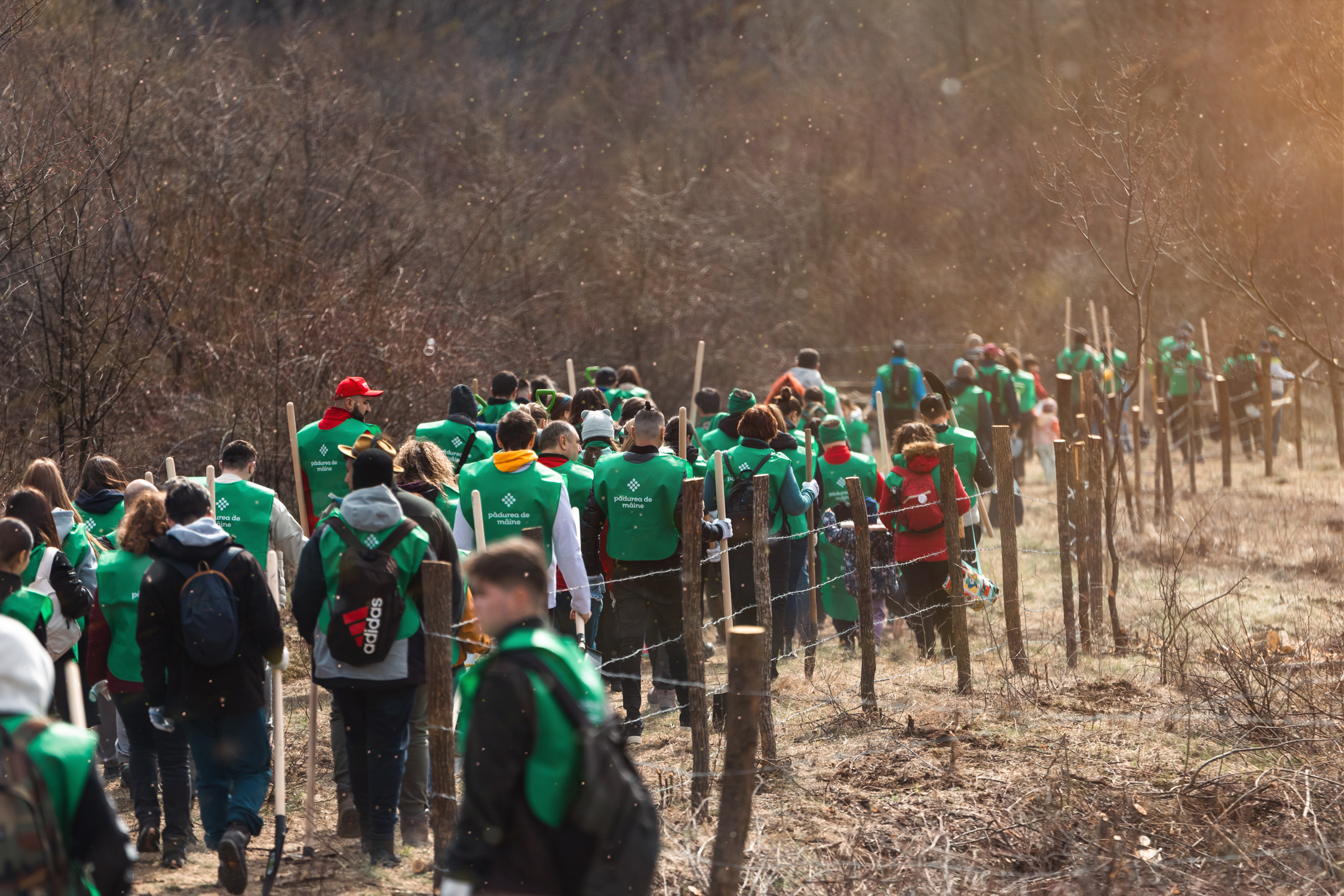
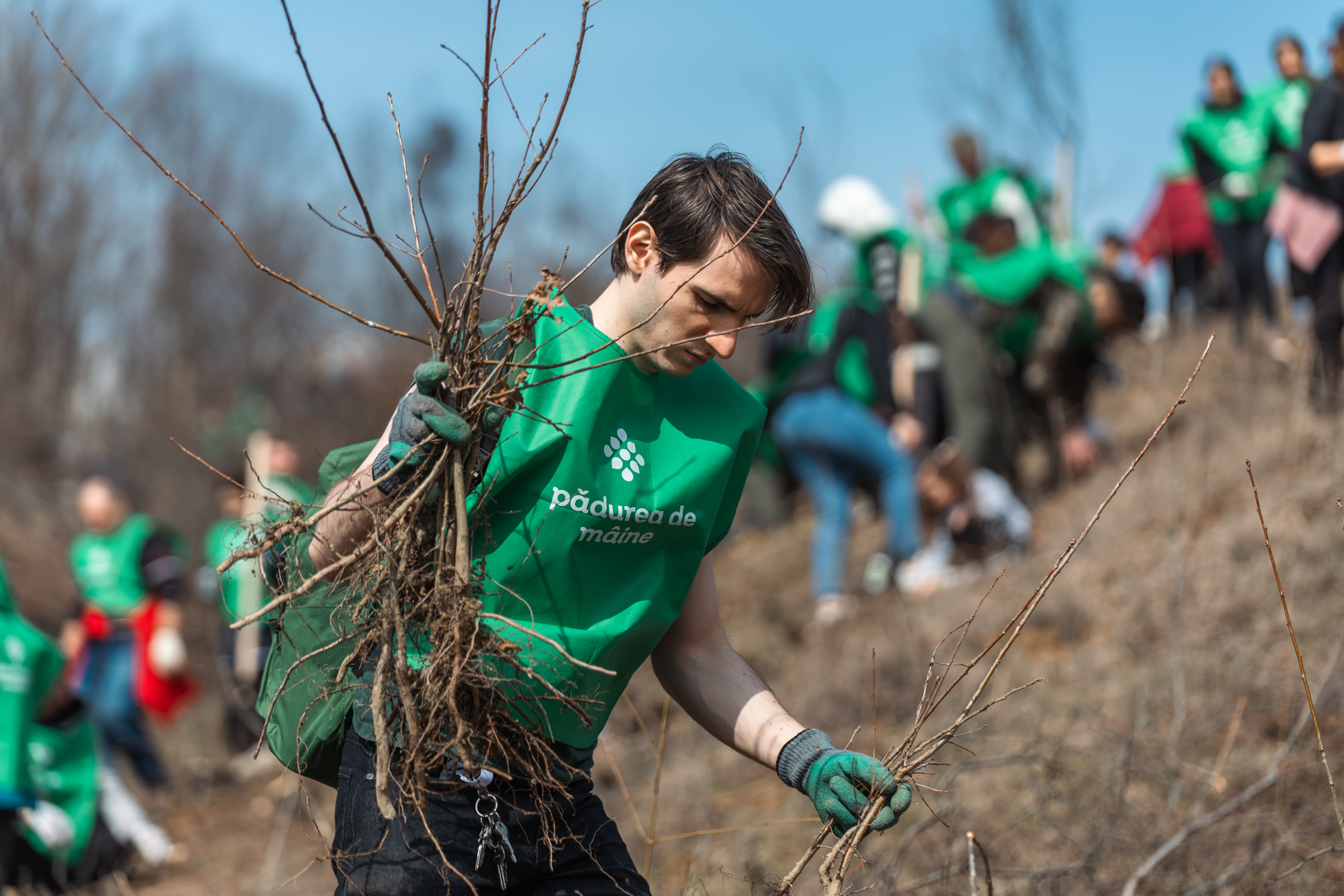
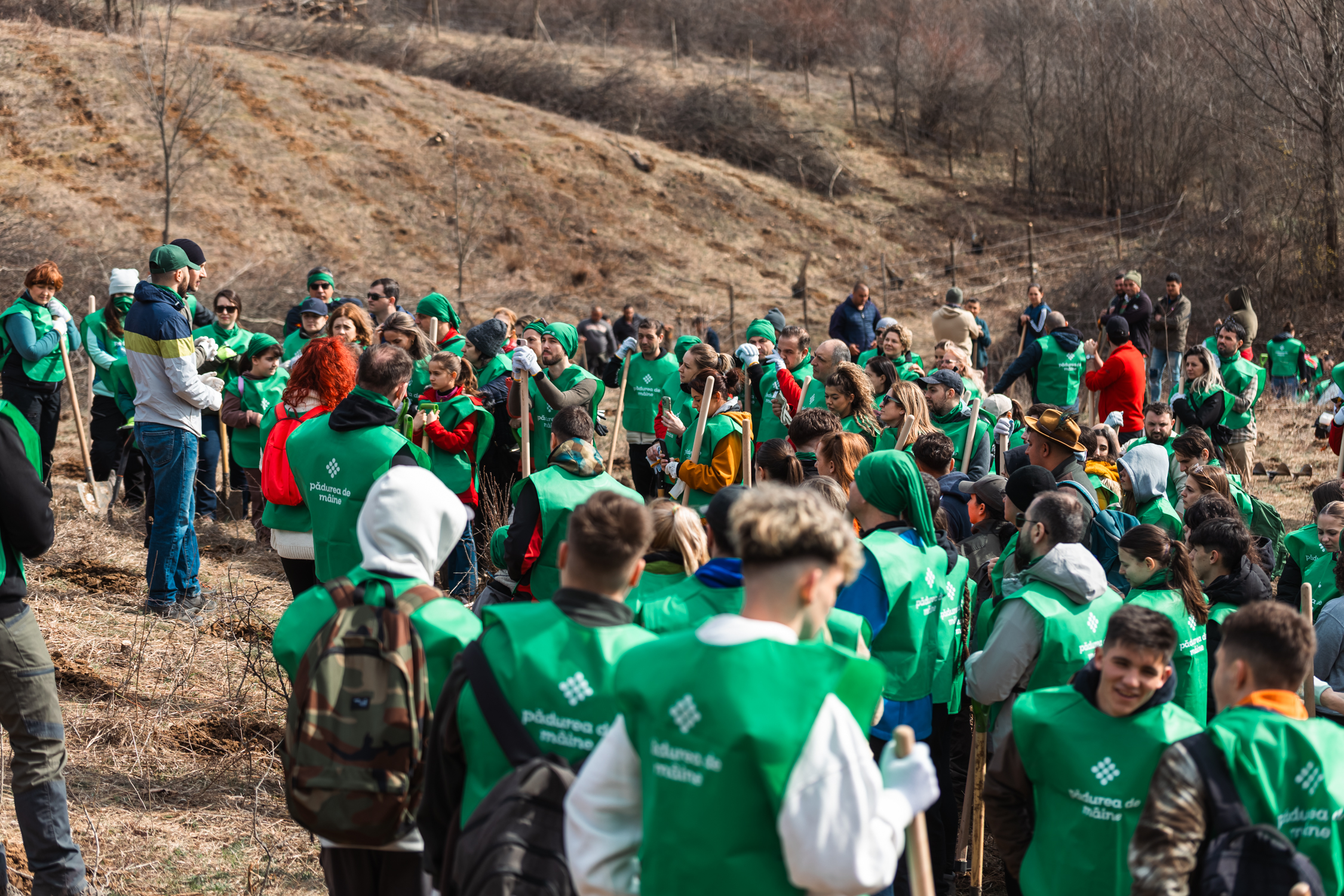
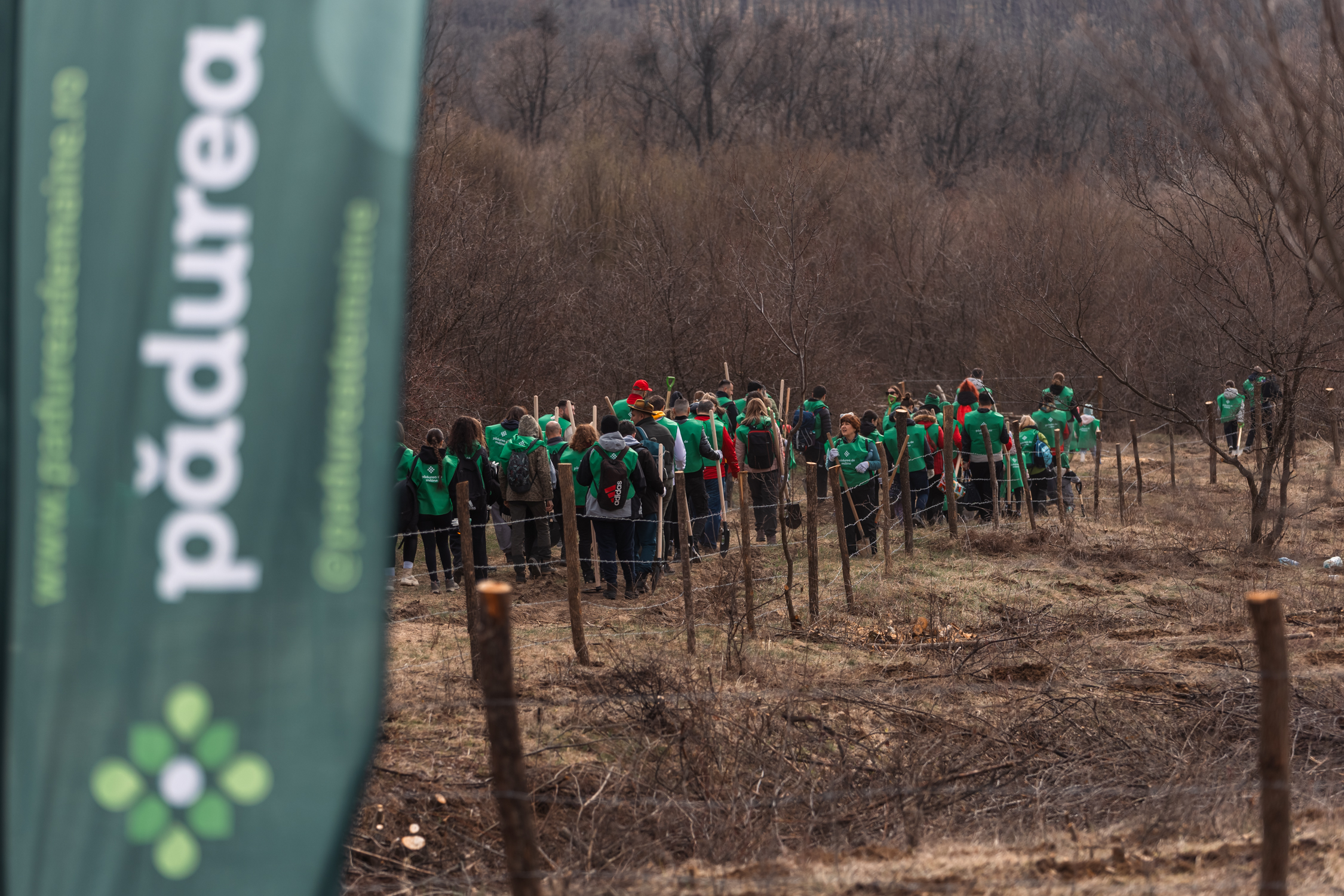
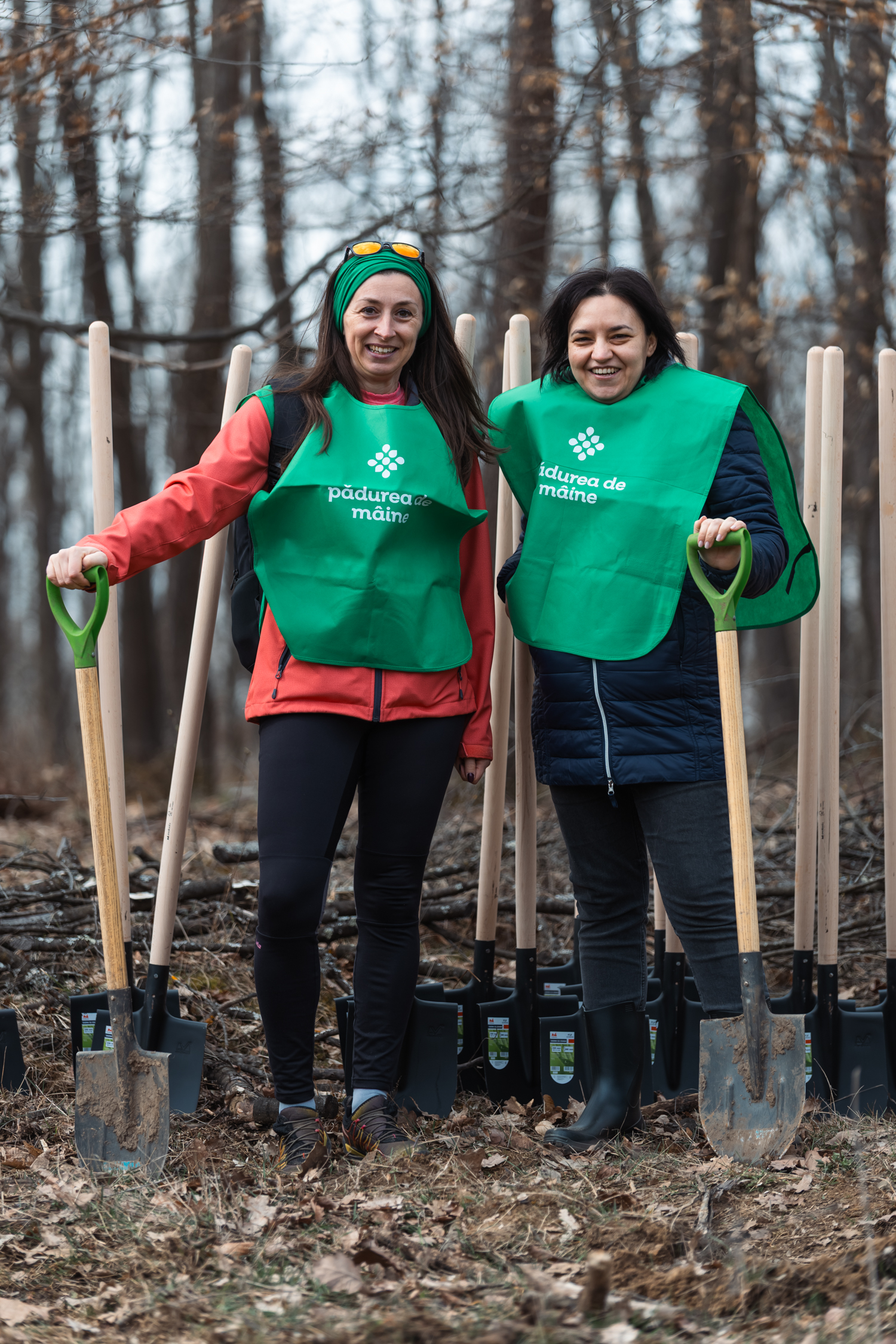
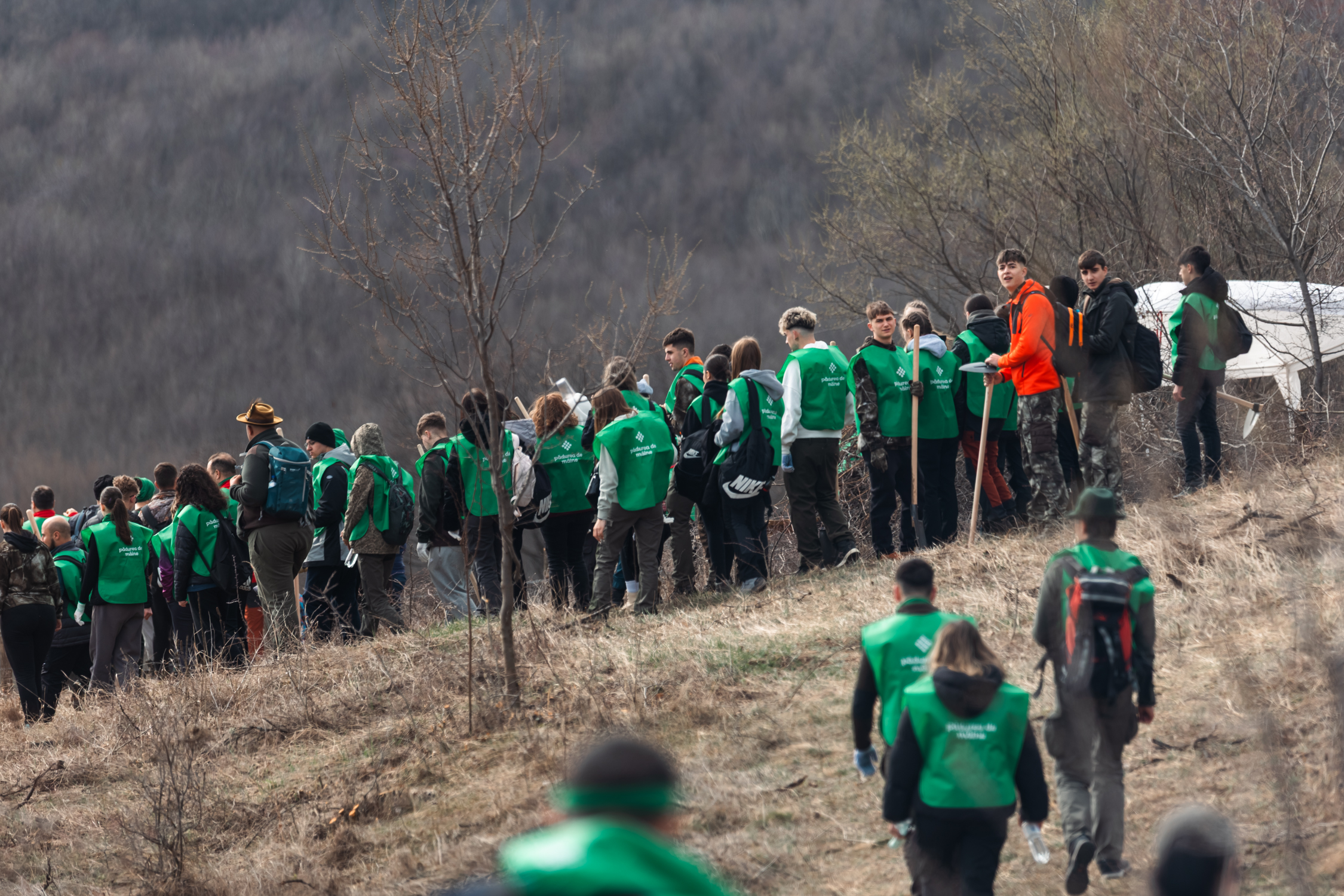
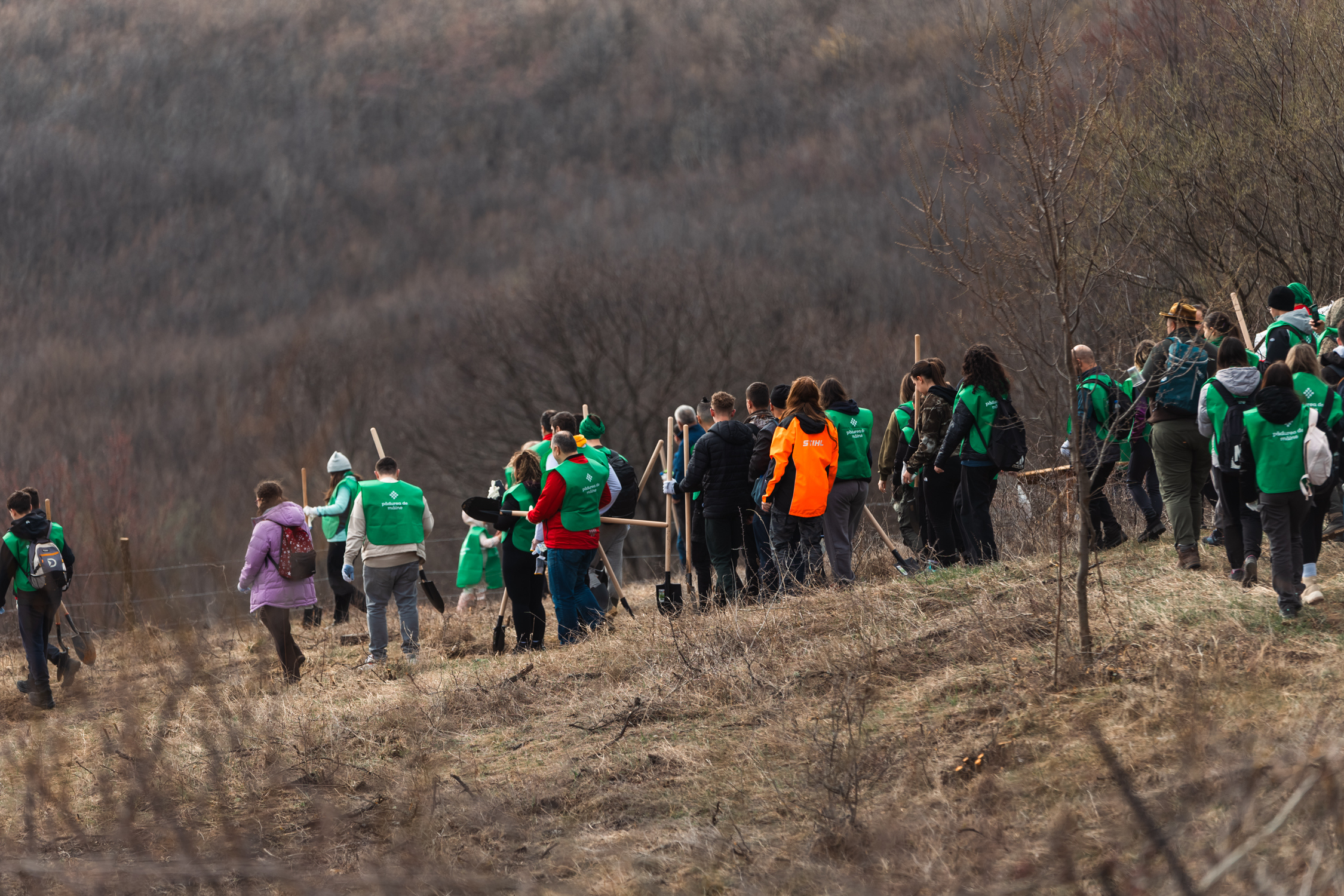
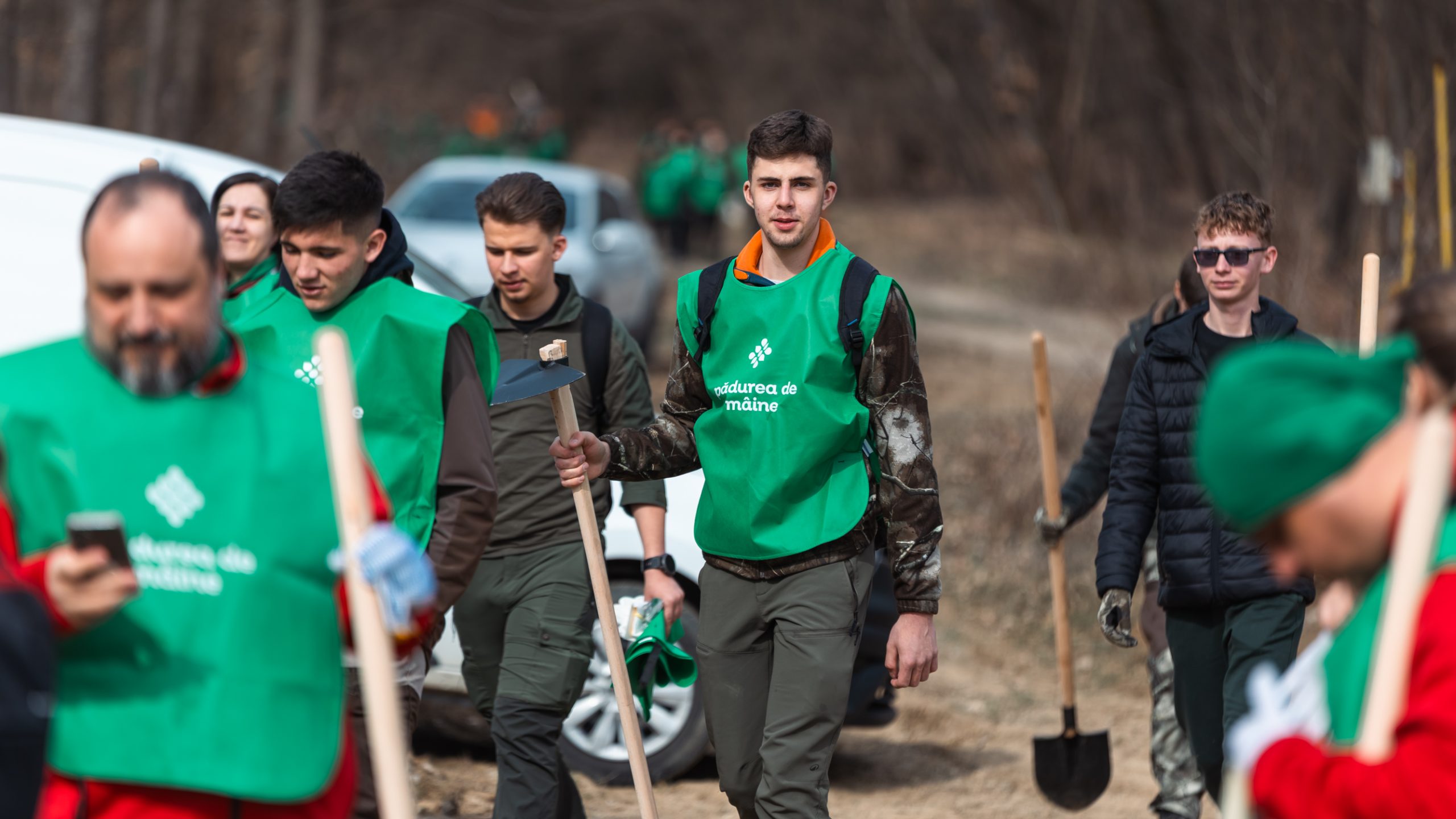
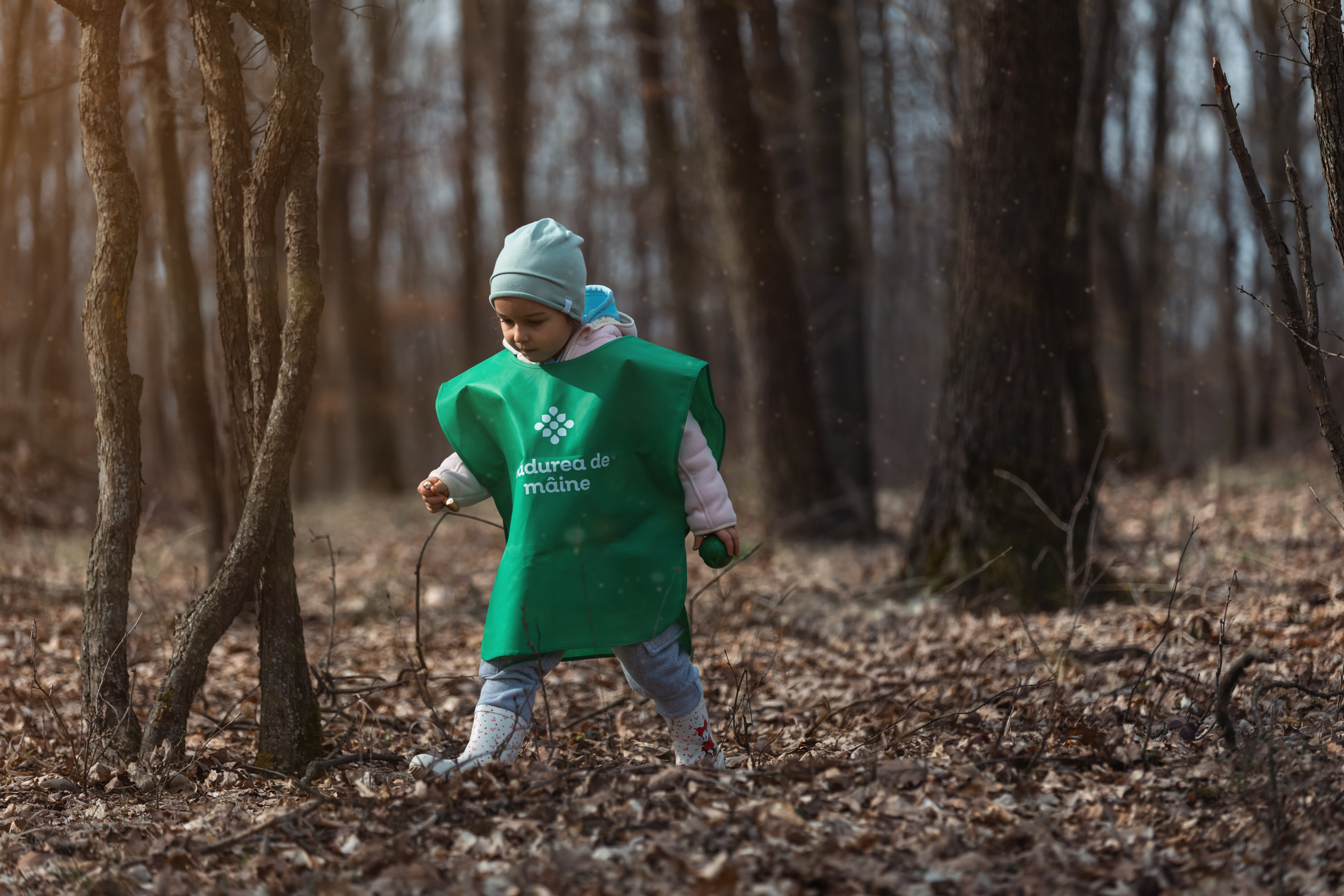
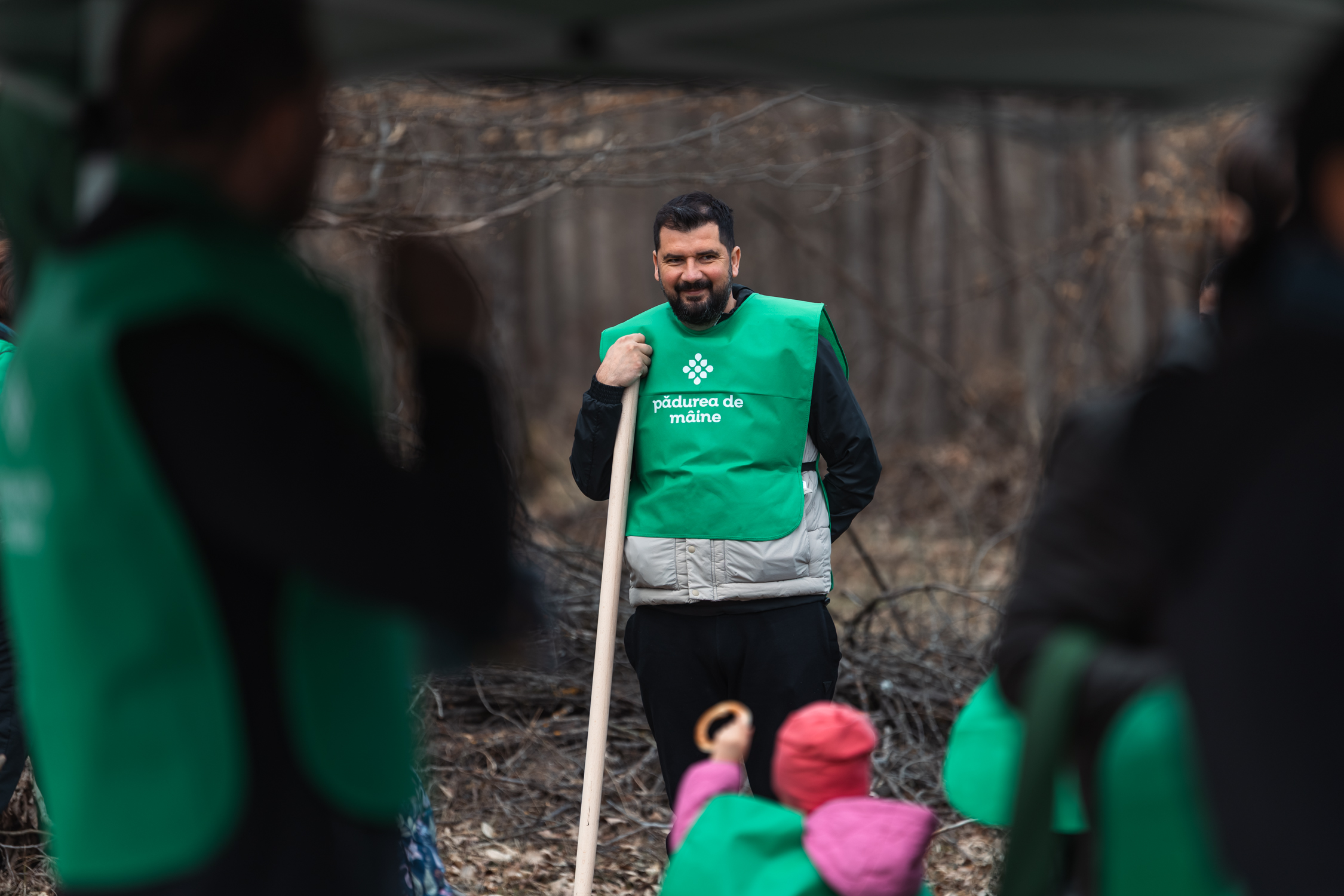
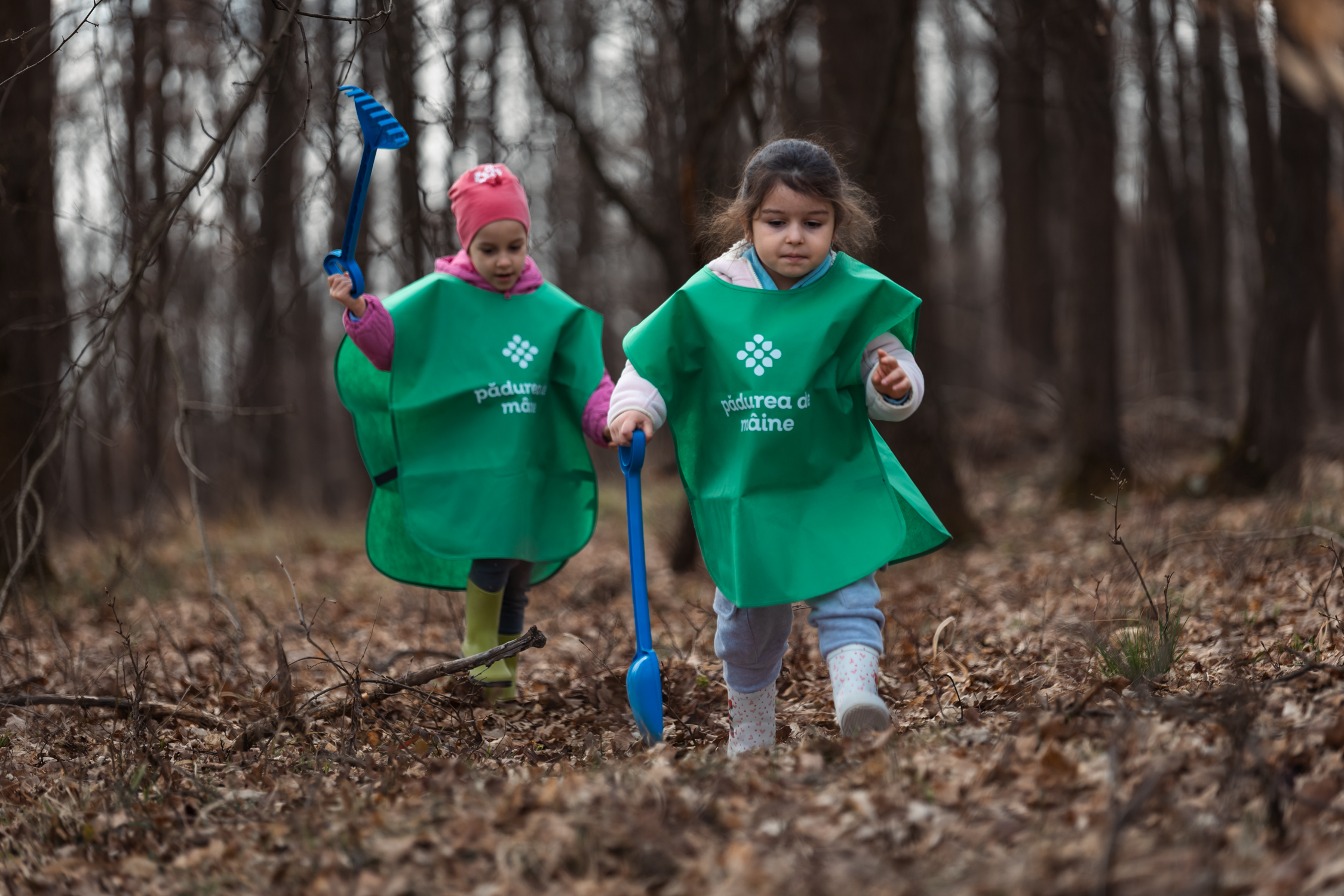
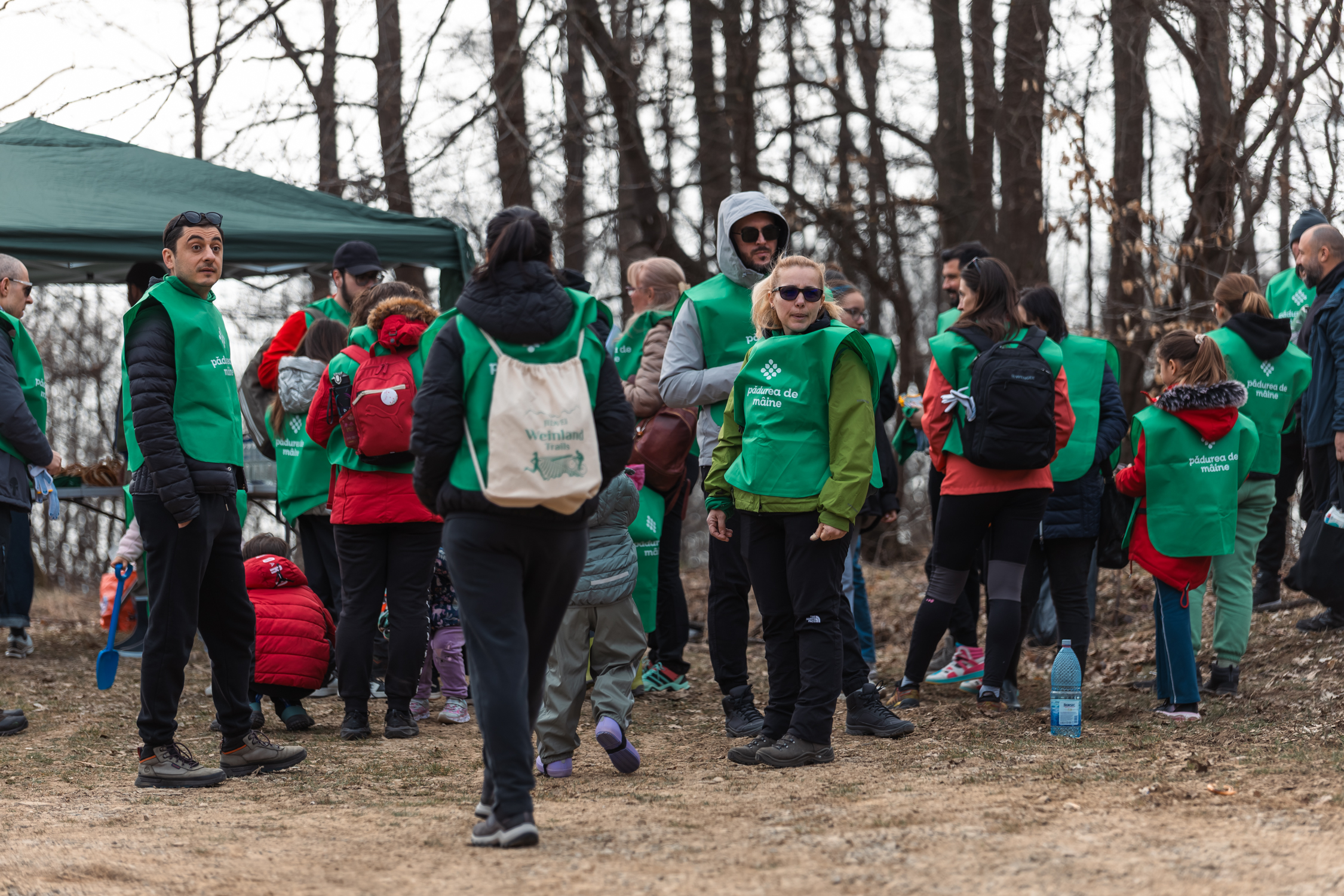
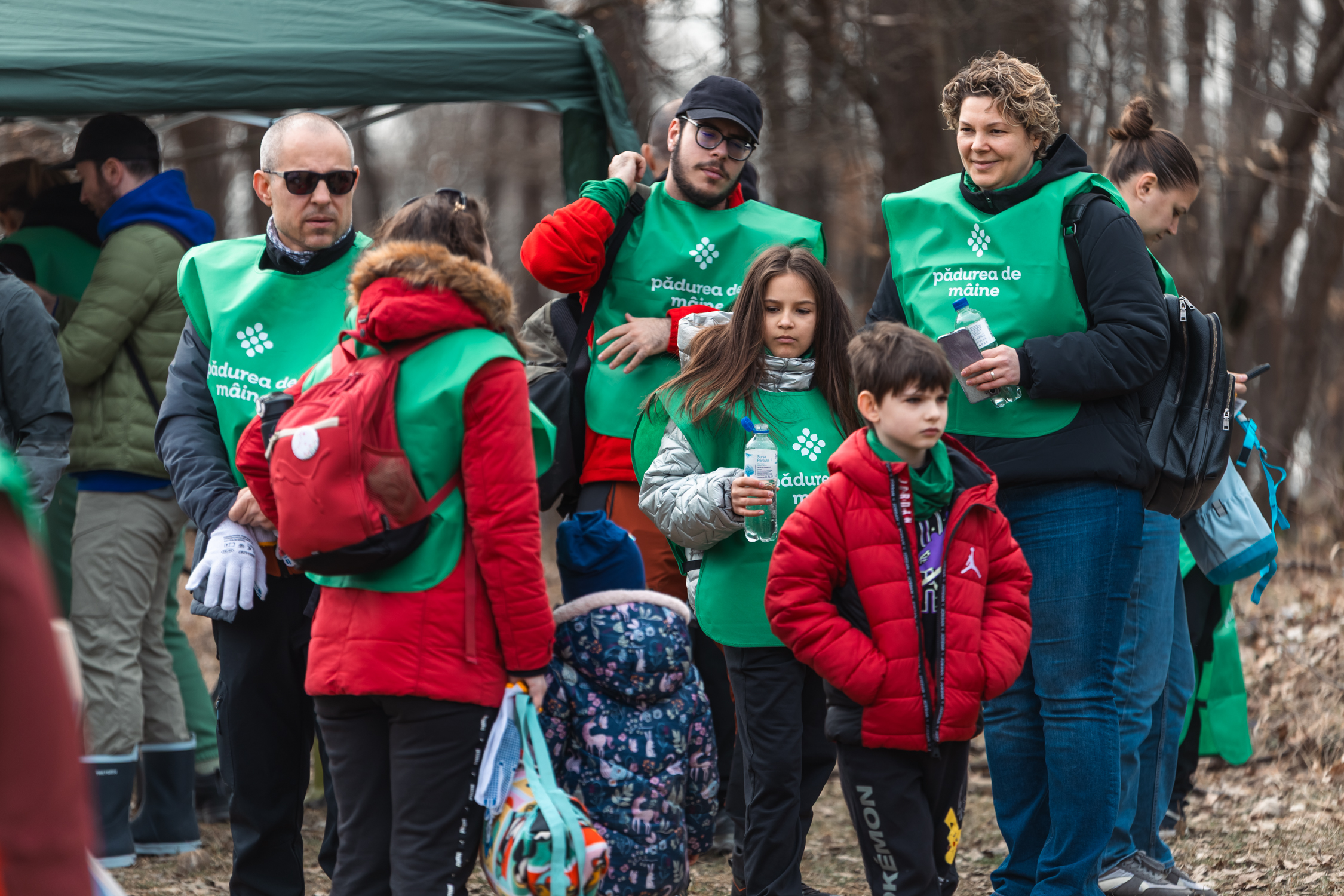
We went to work this year, on March 21 – on the International Day of Forests – together with 160 volunteers in Podenii Noi, in Prahova County. For a few hours, a former communal pasture invaded by spontaneous vegetation became home to 6,000 seedlings on 1.2 hectares of land.
Nothing spectacular, nothing revolutionary – just a day of teamwork, mud on boots and shovels stuck in the ground. But that’s exactly what makes the difference: simple, repeated gestures that add up over time.
An abandoned pasture becomes a forest
The plot at Podenii Noi was not a spectacular area, but a former communal pasture left in ruins, on which spontaneous vegetation had grown without value. In hilly areas, such land remains so for a long time – nature does not regenerate a functional forest on its own without a boost.
We chose to plant 6,000 seedlings in a density that allows the trees to grow healthy: close enough to protect each other from wind and drought, but not so crowded that they suffocate each other. They will provide shade for each other, forcing growth vertically instead of spreading sideways – just like a natural forest grows.
“The International Day of Forests gave us the opportunity to bring the community together around an initiative that transforms an unproductive land into a forest for the future,” says Mihail Caradaică, executive director of the Tomorrow’s Forest Foundation. “We are happy to see how many people choose to get involved and support these projects, either by being present in the field, or by donating or redirecting 3.5% of their income tax. Such actions show that responsibility towards nature can become a joint and constant effort.”
Species chosen to withstand the times
We didn’t plant randomly. The pedunculate oak and the Turkish oak represent almost 80% of the total number of seedlings – pillars of stability for the local ecosystem, species resistant to thermal variations in Prahova and able to cope with the prolonged drought and climate change that are already being seen in the area.
The wild cherry adds biodiversity and provides food for birds and small mammals. And the honey locust, planted around the perimeter, has a protective role – a kind of green grid that defends the wooded area from animals or other pests from the outside.
“We aimed to create a mixed forest adapted to local conditions, with resistant and complementary species, which would support biodiversity and stabilise the soil,” explains Ștefan Uțu, coordinator of the Afforestation Programme of the Tomorrow’s Forest Foundation. “In the coming period, our priority remains to take care of the plantation and monitor its development, so that the results are sustainable.”
Our work does not end when the volunteers go home. Three years of care and monitoring follow, until we are sure that the seedlings have caught on and the forest can sustain itself.
Community, not just numbers
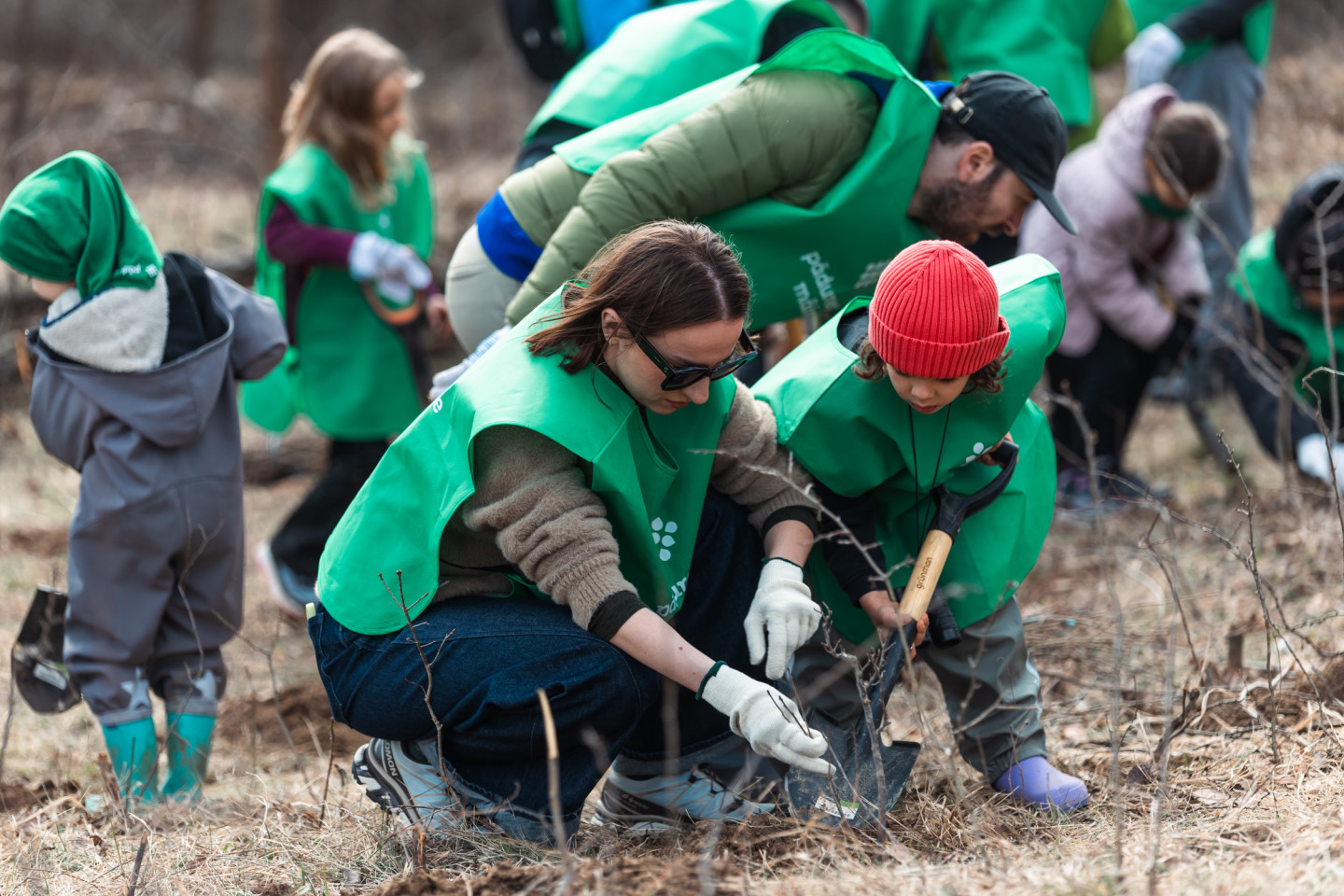
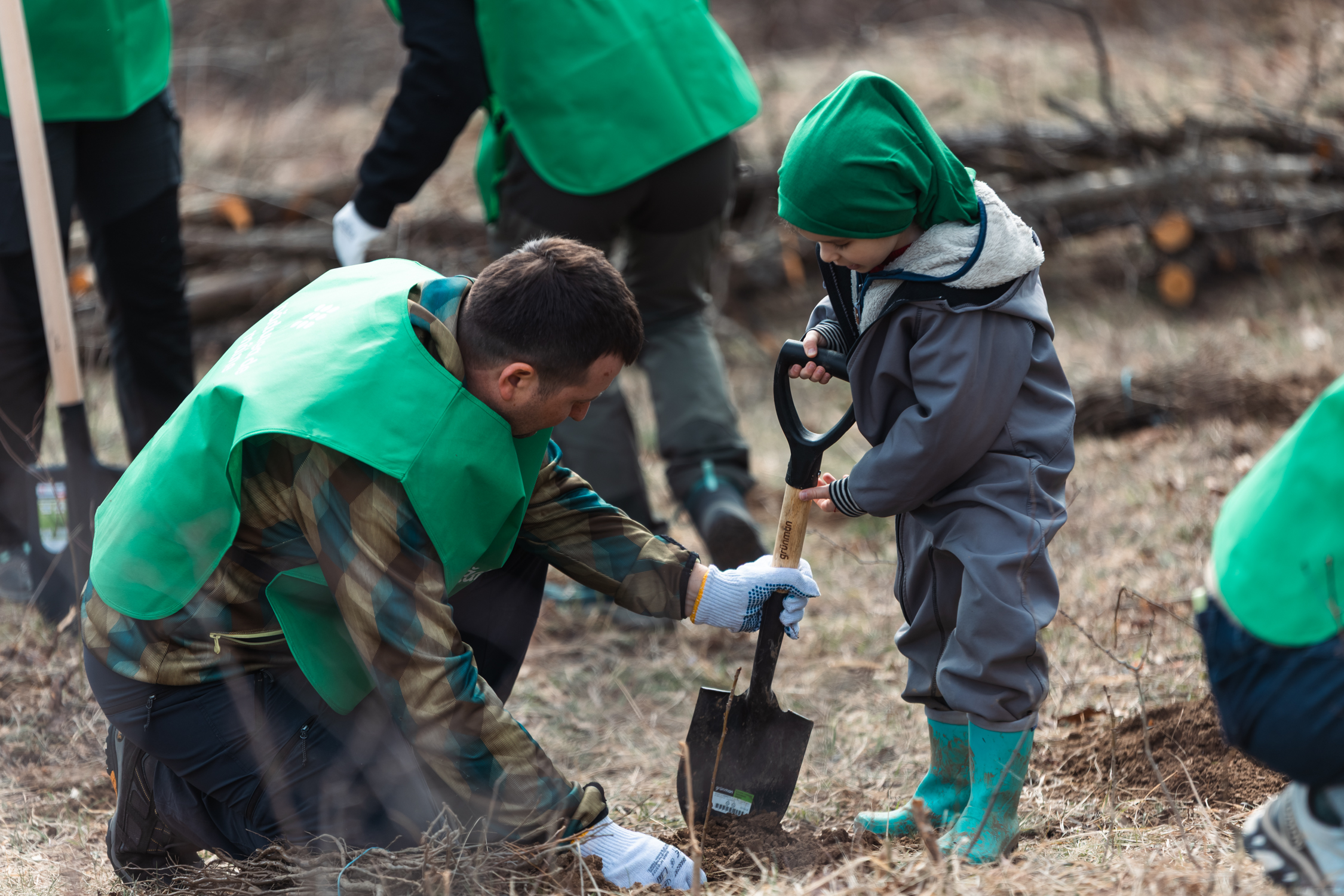
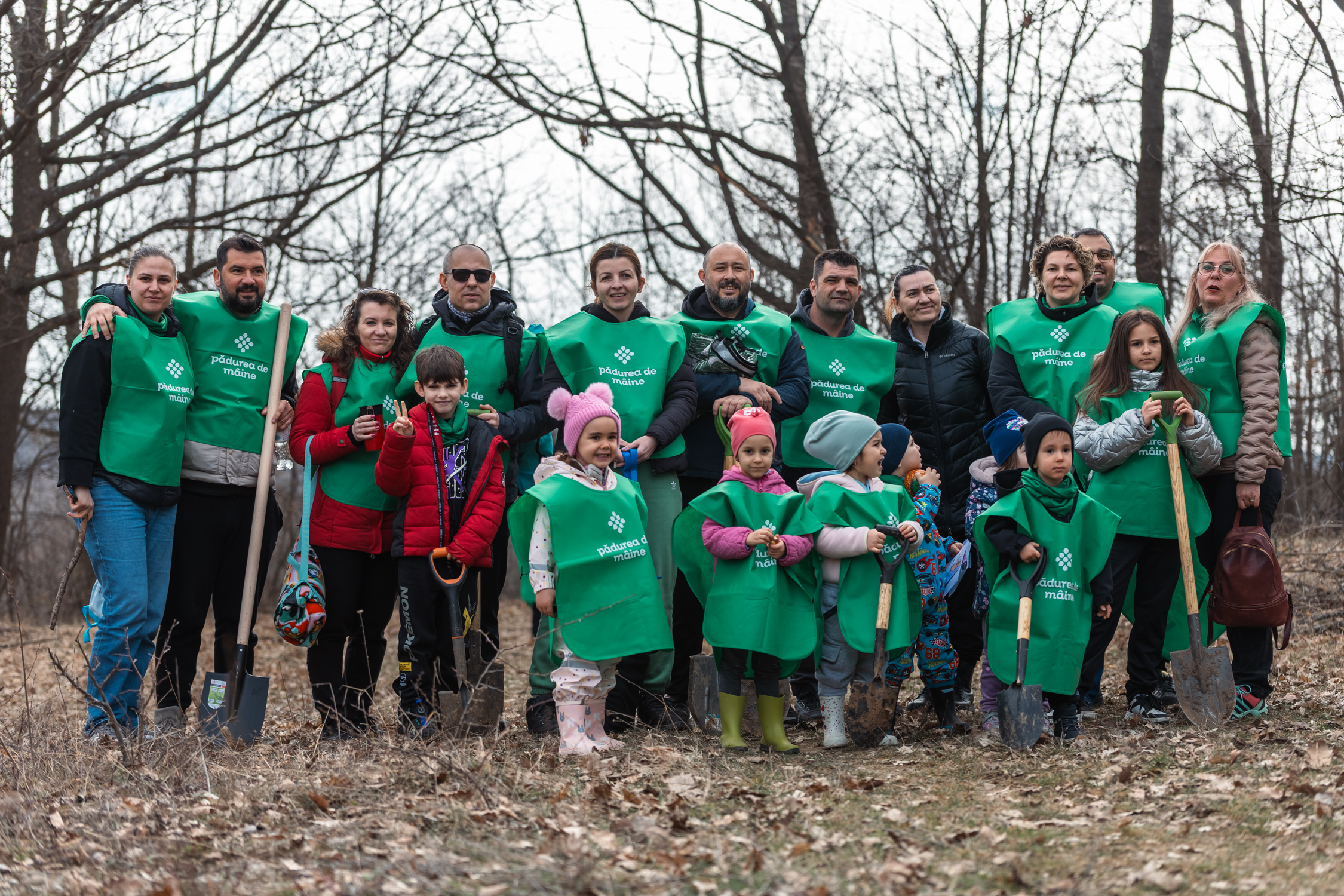
The action was attended by the Foundation’s volunteers, students from the “Dr. Nicolae Rucăreanu” Forestry Technological High School in Brașov, children from the Montessori Educational Centre and the Clopoțel Kindergarten in Sector 2, Bucharest, as well as teams from Claim Expert Services and Global Assistance Services.
160 people of all ages, with different experiences, but with a common goal: to create something that remains.
Antonia Anton, project manager at the Foundation, summarises the day as follows: “For me, the day at Podenii Noi meant the energy of the people who came to do something concrete for nature. It was a warm atmosphere, an example of collaboration between volunteers, students, children and partners of the foundation, in a context that emphasised involvement and responsibility. Such projects are not just about planting, but they build communities and create a direct link between people and the forest, which is essential to be able to build something that remains together.”
What’s next
The 6,000 seedlings in Podenii Noi are not just a figure or an event on the International Day of Forests. They are the beginning of a forest that will grow in the coming decades, absorb carbon, stabilise the soil and provide shelter for local biodiversity.
Forests grow slowly, but their cumulative impact is huge. Every seedling we now plant in the ground counteracts the effects of global warming – now and 20 years from now. It’s an effort that comes together and needs continuity.
We thank all those who participated in this action and those who constantly support us – either on the ground, or through donations or the redirection of 3.5% of their income tax. The forests of tomorrow start with our actions today.
More photos available on our Facebook page!
Help us plant more forests in 2026: for every small donation, we plant a seedling in your name!